7 Signs Your Chimney Needs Repair
· 6 min read · Keystone Chimney Repair
Most chimney problems announce themselves months before they get expensive. The trouble is that the warning signs look like normal aging, so people wait. Here is what to look for and how seriously to take each one.
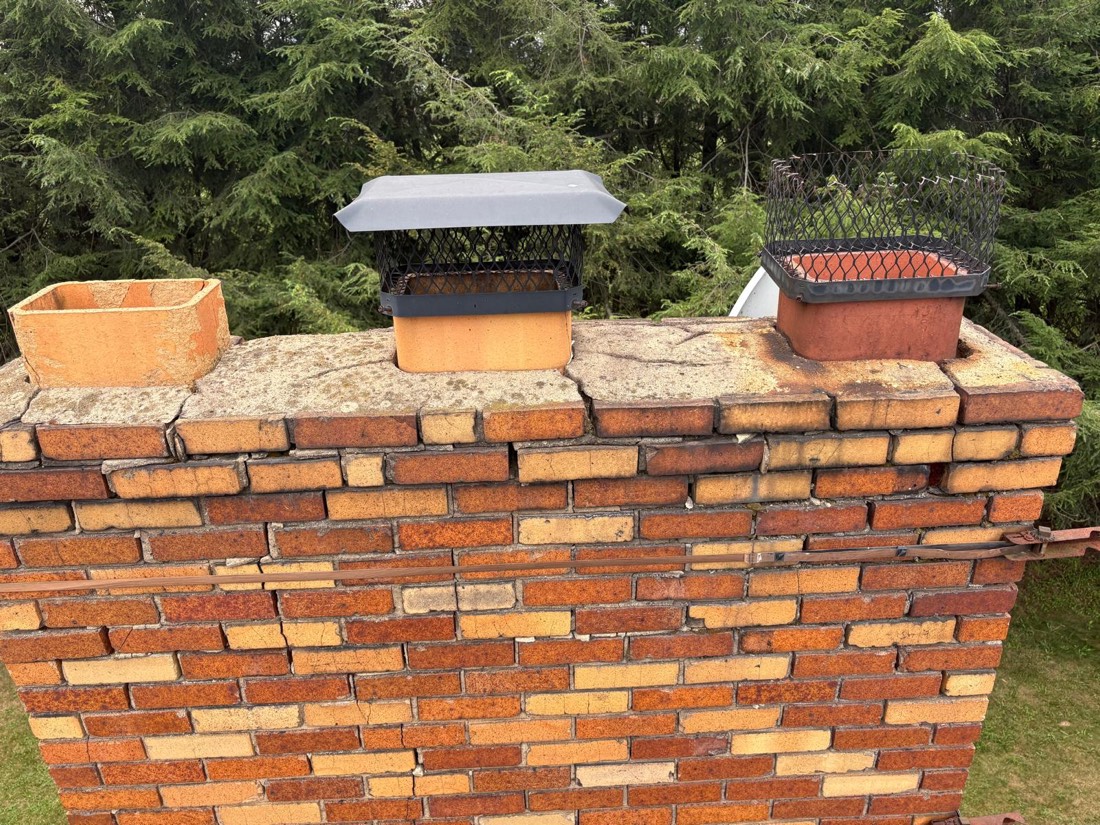
Start from the ground, with binoculars
You do not need to climb anything to spot most of this. Stand back from the house on a clear day and look at the chimney with a pair of binoculars. Then walk inside and look at the firebox and the ceiling around the chimney chase.
Five minutes of looking twice a year catches nearly everything worth catching.
1. White chalky staining on the brick
That white crust is efflorescence. Salt deposits left behind when water moves through masonry and evaporates on the surface.
It is not the problem itself. It is proof that water is getting into the brick and traveling through it, which means something above is letting water in. Scrubbing it off without fixing the source just gives you a clean chimney that stains again next spring.
How urgent: moderate. It means water intrusion is already happening.
2. Mortar joints you can scrape out with a key
Healthy mortar is hard. If you can dig it out with a house key or a screwdriver, or you can see gaps and shadows between bricks from the ground, the joints have failed.
Once mortar is gone a half inch deep, water runs straight into the wall of the chimney instead of shedding off it. In Pittsburgh that water freezes, expands and pushes the brick apart from the inside.
This is tuckpointing work, and it is one of the cheapest repairs on the list when you catch it at this stage.
How urgent: address within a season or two.
3. Brick faces popping off
Spalling is when the face of the brick flakes, pops or crumbles away, leaving a rough pitted surface. Sometimes you find the flakes in the gutter or on the roof below.
This is freeze and thaw damage, and it means water has already soaked into the brick body. Spalled brick cannot be repaired. It has to be replaced, and every winter you wait adds more of it.
How urgent: high. The damage compounds every freeze.
4. A cracked, crumbling or missing crown
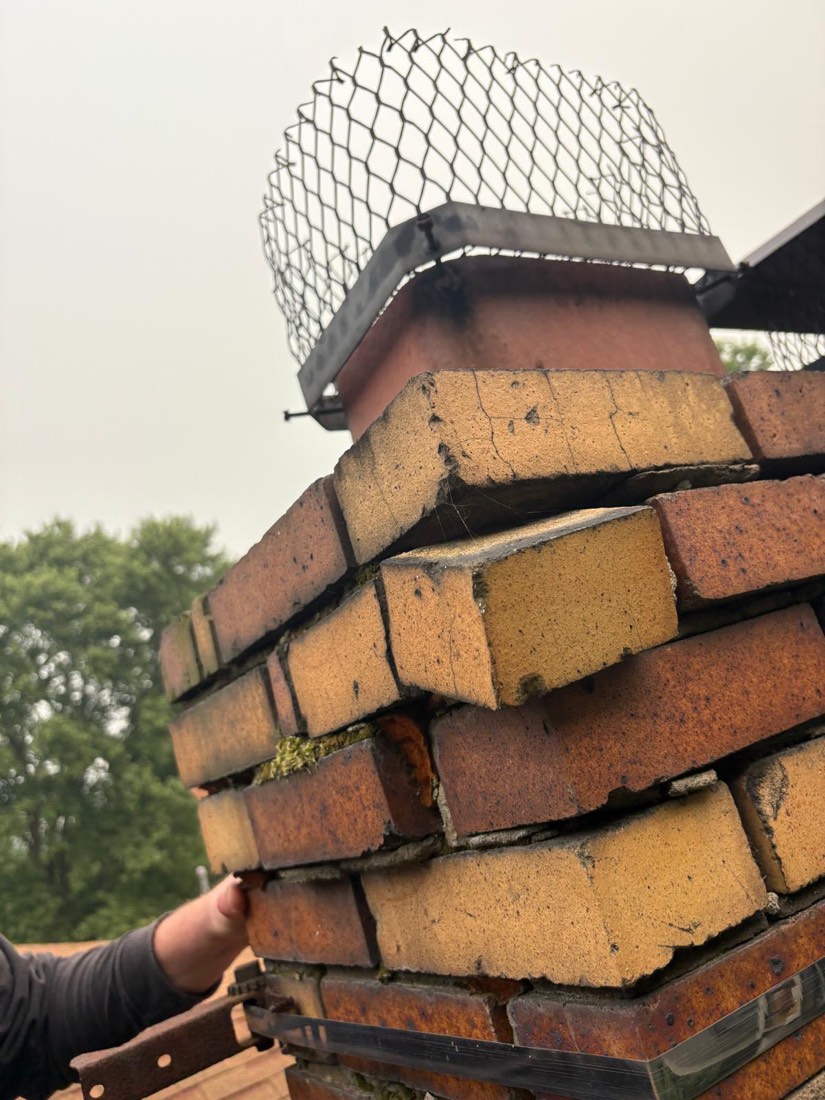
The crown is the concrete slab across the top of the chimney. Its whole job is shedding water away from the brick and the flue.
Builder crowns are often poured thin, and thin concrete cracks. Once it does, water runs directly into the top of the chimney where nothing is protecting it. A cracked crown is behind a large share of the leaks we get called about.
How urgent: high, but usually a straightforward fix if the brick below is still sound.
5. Rust on the damper or the firebox
Open the damper and look for rust, or check whether it still opens and closes cleanly. Rust inside a chimney means moisture that should not be there.
Rust on metal is also an early warning for the flue tiles you cannot see. Where metal is rusting, clay tiles are often cracking.
How urgent: get it inspected. A camera run through the flue tells you what the damper is hinting at.
6. Water in the firebox, or stains on the ceiling
Water pooling in the firebox after rain, damp patches on the wall beside the chimney, or a brown stain on the ceiling near the chase all point the same direction.
By the time water is visible inside the house, it has been moving through the structure for a while. This is the sign people most often misread as a roof problem when it is actually the chimney.
How urgent: high. Water inside means active damage.
7. A stack that looks like it is leaning
Sight the chimney against the corner of the house or a vertical line on the roof. If it leans, tilts or has a visible gap where it meets the roofline, stop using the fireplace and call someone.
A leaning stack is structural. This is the one sign on the list that is genuinely dangerous rather than merely expensive.
How urgent: immediate.
What to do with what you find
One sign on its own usually means a small repair. Several at once usually means water has been getting in for years and the fix is bigger.
Either way the next step is the same. Get someone on the roof with a camera who will show you photos of what they found and put a recommendation in writing. Anyone who quotes a rebuild without going up there and photographing it is guessing, and you are the one paying for the guess.
Not sure what you are looking at?
Text us a photo of your chimney and we will tell you what we see. Free inspections across Pittsburgh, Mt. Lebanon, Upper St. Clair and Bethel Park.
Call (412) 202-3755